- HOME
- Builder
- Green Homes
- Log Homes
- History
- Process & Terminology
- Links
- Contact Us
Welcome to Angels Log Homes Inc.

"Love makes a House a Home..."
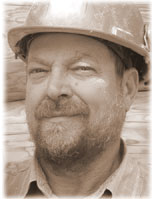
Why choose Dave Dorish to build your home?
 
Dave Dorish has journeyman tickets for both Carpentry and Log House Building.
This means a four year apprenticeship for each ticket, with inter-provincial exams that Dave passed with flying colours. He holds a Certificate in Structural Engineering, SAIT, Alberta. He has been a carpenter for thirty years, and has been working in the log building industry for thirteen of those years.
He is passionate about his work and his integrity. He is also a member of the International Log Builder’s Association.
Dave builds log homes and timber framed homes.
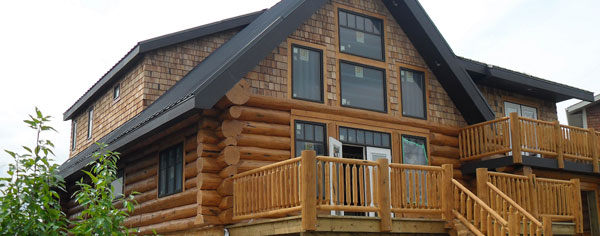
These techniques can be applied to many different buildings, including houses, cabins, retreats, offices, shops, duplexes – the list goes on and on! Yet the nature of log construction ensures that every building is completely unique – as no two trees are identical. Logs make for a very earthy construction that no other material can match, grounded to nature.
Dave can provide custom log “accents” to your home, if you prefer.
Customer comfort is paramount for Dave.
Dave is able to work with existing plans, but he really believes that every house should be designed to suit the land. He can design a home for you that will truly be part of your land – and your lifestyle.
We build according to National Building Code. But we go further than that, to ensure the quality and safety of your home:
- We strive to provide exceptional customer service, with attention to detail. And we work directly with you, our customer.
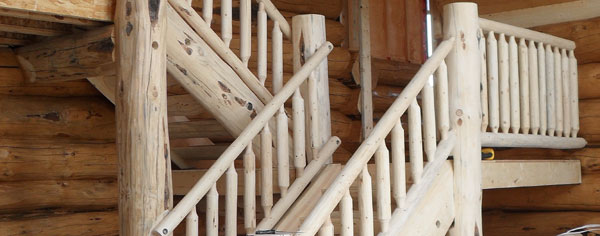
- Logs are chosen for quality, and peeled by hand.
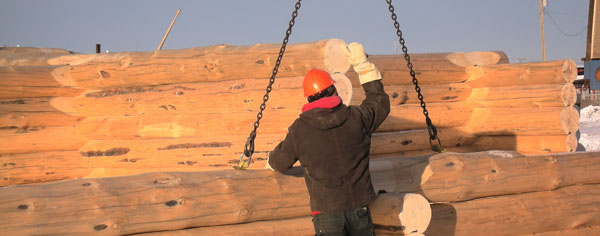
- Many builders use log-tongs to move logs. These leave holes in logs: we don’t believe in marring the beauty of your logs this way.
- All surfaces are plane – cut, not sanded. This gives you a smoother, cleaner finish.
- We use EMSEAL – a high tech sealant tape that expands and contracts with your logs.
- We use a “yard guard” that has been rated as environmentally preferable, certified by Environment Canada’s EcoLogo program. This protects logs against rot, mold, UV breakdown and insect damage during construction.
- We use sheep’s wool batting, not fibreglass, to insulate between lateral grooves and notches. This is safer for everyone, and environmentally friendly.
- Our commitment to building environmentally friendly homes includes providing you with information, resources,
and sources that will enhance your home – inside and out.
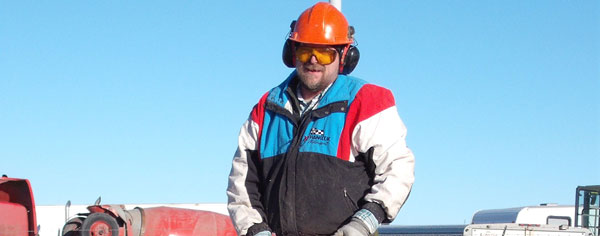
- We adhere to safety standards on job sites.
- Owners are welcome to participate in the building process, under Dave’s direction.
- We have fun, because we love what we do.
Dave’s world view where log homes are concerned:
“My want for the future is simply happiness – for everyone. I choose to work towards this through the log or timber frame homes that I build.
Quality and reliability are two keys to this success: reliability of that quality as well as our integrity (truth/HONESTY). A person’s integrity is very, very important. I would be naïve to think that I or anyone else can please everybody all of the time! But we must be positive and say that all we can do is try!
Also, quality employees: Angel’s Log Homes Inc. aims to hire people who aspire to these philosophies. These people will work with us, not for us!”
Green Homes
At Angels Log Homes, we recognize our role in working towards a healthy planet. To that end, we endeavour to seek out suppliers of sustainable, environmentally friendly products, and we encourage our clients to think green as well.
Green products we use:
- Logs from Forest Stewardship Council (FSC) Certified logging operations (see definition below)
- We use sheep’s wool batting for insulation between lateral grooves and notches (not fibreglass)
- We protect logs from rot, mold and UV breakdown with a “yard guard” that has been rated “environmentally preferable”, certified by Environment Canada’s EcoLogo program.
We have also made a commitment to an annual planting day, where we plant one tree for every saw log used by our company in the previous year.
Green Home Options: Possibilities to Consider
You can start the process of building a green home by seriously considering how big your home really needs to be. Try reading Robbin Obomsawin’s book Small Log Homes: Storybook Plans and Advice, for ideas on how to make your log cabin more space-efficient.
Incorporating any of these products into your home could help you to make a difference to the environment, the quality of your home, and your health – not to mention reducing your long-range bills!
- Upgraded insulation
- High-performance, low-e windows
- Geothermal heating
- Passive solar heating (part of the design process)
- Solar-thermal water heating
- Solar-thermal radiant heating
- Fiber-cement siding (in timber frame applications)
- Photovoltaic electric system (for all needs or as supplement)
- Wind energy (where reliable wind source is available)
- Mini-turbine (where reliable water source is available)
- Tank-less (Hot water on-demand) water heater
- Forest Stewardship Council (FSC) rated wood products
- Low Volatile Organic Compound (VOC) paints and finishes
- Formaldehyde-free building products
- Energy-Star labelled appliances
- Carpet made from recycled plastic
- Linoleum flooring, bamboo flooring, FSC-certified hardwood flooring
- Compact fluorescent and/or LED lighting
- Water-conserving taps and shower heads
- Two-button flush toilet
- Composting toilet
And outdoors, consider installing:
- water storage tanks at downspouts (for outdoor water use),
- native, drought-tolerant plants mulched to reduce evaporation,
- trees and shrubs to reduce building heat loss during winter, and to shade during summer,
- contours to hold water in soil.
Grants and Incentives Available for
Green Home Initiatives
http://oee.nrcan.gc.ca/corporate/incentives.cfm
Federal grants and incentives are available to homeowners and small and medium-sized businesses, industry and public institutions to help them invest in energy and pollution-saving upgrades. In addition, selected provincial, territorial and municipal entities also offer grants and incentives to homeowners who conduct energy saving upgrades. Cruise this website to see what is available where you live – it all adds up!
Another book we recommend, if you are looking for ways to make your home more environmentally-friendly, is Good Green Homes: Creating better homes for a healthier planet, by Jennifer Roberts.
What is FSC Certified Wood?
The Forest Stewardship Council (FSC) is an international non-profit organization that has established criteria to help consumers recognize wood products that have been harvested from forests that are being managed in ways that are environmentally responsible, socially beneficial to the local community and economically viable in the long term.
Their certification ensures that, in the harvest of trees for wood products,
- Waterways are protected;
- Wildlife habitat and species are protected;
- High conservation value forests are preserved;
- Forest management practices are monitored annually;
- Genetically modified trees are not used;
- Pesticide use is reduced;
- Local people are involved in forest management.;
- The rights of Indigenous Peoples are respected.
We are endeavouring to use FSC certified wood products in our construction to support the efforts of responsible foresters, and to ensure that forests will be healthy and whole seven generations from now.
For detailed information on this certification process, see the FSC website at http://www.fsccanada.org.
Earth-Friendly Landscape Design
By Karin Dorish
In Earth-friendly landscape design, the relationships between plants, animals, people, and buildings are taken into account –
creating a healthy, sustainable whole.
Karin’s goal is to provide a landscape design that fits with who you are, that will respond to your home’s structure, and that requires a level of maintenance that you will feel comfortable with. Service includes one free hour of initial consultation, a scrapbook that contains your design, tips for maintenance, recommended reading & plant resources, as well as “before” photos to jump-start your project. This design becomes your ACTION PLAN for your yard – no matter how long it takes to implement, the result will be a cohesive whole. Karin can also provide maintenance training, and instruction or information sheets on a wide range of topics.
Karin has been gardening for over thirty years, with a focus on landscape that is healing to a space, as well as those who share it. If you would like to make your yard wildlife-friendly, Karin will include plants, trees, and shrubs that will feed and shelter them. Focusing on native trees, shrubs and plants not only reduces water dependency: it helps us to fulfill our role of Earth Stewards. Karin also likes to increase your own food self-sufficiency (by planting shrubs that bear edible fruit, for example) and to incorporate water conservation techniques in her designs.
OUR GOAL IS A TOP QUALITY HOME FOR YOU!
CONTACT US TODAY!
Log Homes : : History in the Making
When you build a log or timber frame home, you become a part of a long legacy of construction spanning many centuries (and still evolving today).
Pioneers built their cabins without scribing. This meant their cabins required chinking. The gaps between logs would be packed with branches, straw, moss, mud, manure – anything that would fill the gap and keep out the wind. Today, chinking consists of polystyrene backer rod, with high tech caulking.
All log homes settle over time. Modern log home technology uses a method that works with the gravity and settling of logs. This involves scribing, where a lateral groove is cut into the bottom of a log, allowing it to fit snugly around the log below.
Timber frame construction differs from log home design. Logs are used to frame the house (interior beams are generally left exposed, for aesthetics), but structural insulated panels are used to envelope the building. This could be vinyl siding or stucco finish.
Building Design : : Customer comfort is paramount for Dave.
Dave is able to work with existing plans, but he really believes that every house should be designed to suit the land. He can design a home for you that will truly be part of your land – and your lifestyle.
Our preference is custom-design, built to suit your land and your particular needs – including size and log species-preference. Your family and your land are unique, and your home should reflect that. We can work to any plan, however, if you have already found one that you like best.
In the following section, you will find our tribute to some of the cabins of yesterday, and the people who built them and lived in them. Today, these cabins would likely fit in the category of “cottage bunkie”. Few amoung us would be comfortable living in something as snug as these designs represent. However, for those of you looking for something small and different, or needing “just a bit more space” for “just a few more relatives”, or even simply a “room of one’s own”, maybe such a small design would do nicely.
History
Log cabins are all about history, and the stories of the remarkable people who made the history. This section represents our tribute to some of the cabins of yesterday, and the people who built them and lived in them. Today, these cabins would likely fit in the category of “cottage bunkie”. Few amoung us would be comfortable living in something as snug as these designs represent. However, for those of you looking for something small and different, or needing “just a bit more space” for “just a few more relatives”, or even simply a “room of one’s own”, maybe such a small design would do nicely.
Catherine Parr Traill
Catherine was born in 1802 to a wealthy British merchant and warehouseman. She and her younger sister, Susanna, married officers retired from the Napoleonic Wars. They both chose to immigrate to Upper Canada in 1832. As both husbands were
also younger sons, with no possibility of inheritance, the Colonies offered new opportunities. So it was that Catherine Parr Traill and Susanna Moodie came to the wilderness of Upper Canada, near what is now Peterborough, Ontario. Both sisters wrote at length in published works (still in print) about their experiences. Here their true natures were revealed, as Susanna was embittered and angry, and Catherine enthusiastic and adventuresome. Susanna and her husband were never able to overcome their Upper Class prejudices regarding the Lower Classes, and thus were ostracised by their neighbours – most of whom were escaping poverty and drudgery (and landowners like the Moodies) in their countries of origin. Catherine and her husband Thomas embraced the land and its people alike, and were rewarded by a tremendously more positive experience. Both families built and lived in log cabins, made like their neighbour’s homes: hewn out of the woods and built by hand.

Gentlemen Ranchers
In the 1880’s, the majority of land and water rights for the lower third of Alberta were held by a handful of wealthy families in England. This was the outcome of cattle speculation, on a scale never seen previously. The opening of the land by rail made it possible to graze cattle on the Alberta frontier and then ship them back to England at a huge profit. Many of the young men who were sent to Canada to oversee their families’ empires were younger sons or even what came to be known as “Remittance Men” – a derogatory term for sons being paid to stay far away from home. In addition, well-educated and well-heeled teenage boys and young men arrived in ever increasing droves, spurred on by lack of opportunities at home, grand tales of adventure and the mystique of the cowboy life. Many had never set foot out of London and had no frontier life-skills. The ones with the best chance of survival came with an endless supply of funds and/or time spent at a school back home specifically designed to prepare them for Frontier Life, such as the Public Schools’ Colonial Training College at Hollesley Bay, near Woodbridge in Suffolk. Courses included such essentials as riding, shooting, surveying, geology, and veterinary science. Guest lecturers at Hollesley Bay included successful ranchers, farmers and backwoodsmen straight from Canada. Some attempts made by ranching “dudes” or “greenhorns” at cabin-construction were better than others – one winter in Alberta would teach them faster and more thoroughly than any manual. Here’s to the ones that stuck it out and came to love the mountains and rolling hills of Alberta!
Prairie Settlers: The Sodbusters
The homesteaders came hard on the heels of the cattle-ranching empire builders. A more diverse range of skills, experience and financial backing would be hard to calculate. They came by the thousands, lured by extravagantly worded posters and billboards. They came from England, Scotland, Ireland, Germany, Sweden, Denmark, Norway, Russia and the Ukraine – to name a few. They came from Ontario and Quebec. They frequently settled in small communities of established people who shared a language and culture. Some were farmers; some had never set foot on a farm before. All shared a dream of land – lots of it. Homesteaders were eligible for 160 acres – if they could prove their ability to clear it and grow crops on it. For most of the homesteaders, this was an impossible amount of land to own “back home” – if they had ever had any hope of owning any land in the first place. Obstacles included tragic battles with ranchers in the south, who viewed the homesteader’s farming efforts as an affront to their previously unchallenged land and water access; as well as weather, disease, hunger, and loneliness – yet they kept coming, and they kept building. On farms all over the Western Provinces can be seen the mostly tumbled and rotting early homes of the families who first cleared the land. Enduring isolation, periodic droughts, and many other hardships with their families, they put down roots in a terribly foreign and unforgiving land – and many thrived. Let us celebrate their tenacity and courage!
Miner’s Cabin
Miners have combed the backwoods of Canada from one coast to the other, depending on the latest find somewhere. During the Klondike Gold Rush, 100,000 people flocked up to the Yukon. Only 30,000 made it. And of those, a handful found enough gold to make their sacrifices and misery worthwhile. The ones who did well, graduated from a canvas tent or rough shack to a snug cabin as quickly as possible. Today, the lure of the metals hidden in rock and earth still draws miners – some in huge operations, others still slugging it out, one day at a time in a one-on-one dance with the earth.
Government Patrol Cabin
When the wilds of Alberta were patrolled by Wardens on horseback (or foot), cabins were built at strategic intervals to provide a reliable source of shelter from unpredictable and potentially deadly weather conditions. Dave’s wife, Karin Dorish, had the privilege to visit such a site while working as a Junior Forest Ranger one summer several decades ago. She had volunteered, along with two other girls, to help the Fox Creek Fish and Game Warden (today they are called Conservation Officers) clean up one of the old Patrol cabins. After a two-hour-long drive over a rough grassy path in a four-wheel drive truck, they arrived at a clearing where two cabins still stood: the “old” and the “new”. The old, original cabin had nearly re-joined the earth it stood on. The “new” cabin was a roomy shelter with bunk beds and a simple kitchen. After a long stint cleaning up inside and out, smokies were roasted on a stick and consumed with fervour. Later that day, after the long drive back to camp, Karin realized with chagrin and dismay that she had left her knife behind at the cabin. Her mom gave her the knife for her sixteenth birthday, and her name was engraved on the blade. To her astonishment, the Fish and Game Warden drove all the way back the next day to pick it up for her. To this day, Karin holds the Fish and Game Wardens (Conservation Officers) in high esteem, and remembers that special gift with gratitude.
Trappers Cabin
Regardless of how people feel about the issues surrounding trapping, trappers represent an important part of the history of Canada. Their trap lines stretched for miles into the wilderness, and like the Wardens, they built small cabins at crucial intervals down their trap lines. Many people owed their lives to being able to take shelter in one of these cabins, not only the trappers themselves, but hunters and others lost or caught in bad storms. Let it be said that taking shelter in a cabin does not mean an invitation to abuse that hospitality – firewood should be replaced, and everything left intact – it is private property, after all.
Process
Looking for help understanding the log house construction process?
We recommend Robbin Obomsawin’s book Small Log Homes: Storybook Plans and Advice; or another book by her titled Log Cabin Classics, for prospective log home owners. Both books have a lot of excellent information for someone building a log home (regardless of size) whether you plan to build your log house yourself, or hire a company like Angel’s Log Homes Inc. to build for you. She will walk through all the stages of making a log home dream come true – from design to construction.
We can also send you a package of resources that we have pulled together that may be useful to your planning process, including FireSmart, alternative energy ideas, and resource maps.
Terminology
Checking: Longitudinal splits in a log resulting from internal stresses caused by drying.
Grain: Direction of arrangement of fibres in wood.
Header: Structural log that supports other logs (such as joists or rafters where they are cut around a horizontal opening, such as a window or door.
Lateral Groove: Groove cut the length of a log (under side) so that it will fit onto the log sitting below.
Lintel: Horizontal log spanning an opening in a wall, such as a door.
Mortise: Square or rectangular recess cut into a log where a tenon will fit.
Notch: Recess cut into a log, where another log will fit into.
Plate Log: Log on the top of a wall that supports the rafters.
Purlin: Horizontal roof beams, running parallel with the wall.
Rabbet: Three sided groove cut into log.
Ridge: The top-most purlin.
Scriber: Tool used to mark parallel lines to match log-on-top-of-log.
Sill: Bottom log for wall, door, or window.
Tenon: A square or rectangular extension at the end of a log to fit into a mortise.
Truss: Part of the roof support system – supports purlins and ridges.
Contact Us
|
You can contact Angels Log Homes Inc. by
calling Dave Dorish at (780) 686-1685.
Or e-mail at
info@angelsloghomes.com
|
|